Providence, that capricious old lady who governs the affairs of men while permitting them to believe they govern themselves, shone her benevolent light upon me one bright Octember morning, when I found myself ambling, though with considerably more intent than an ordinary amble might suggest, along the already bustling High Street of Auld Reekie.
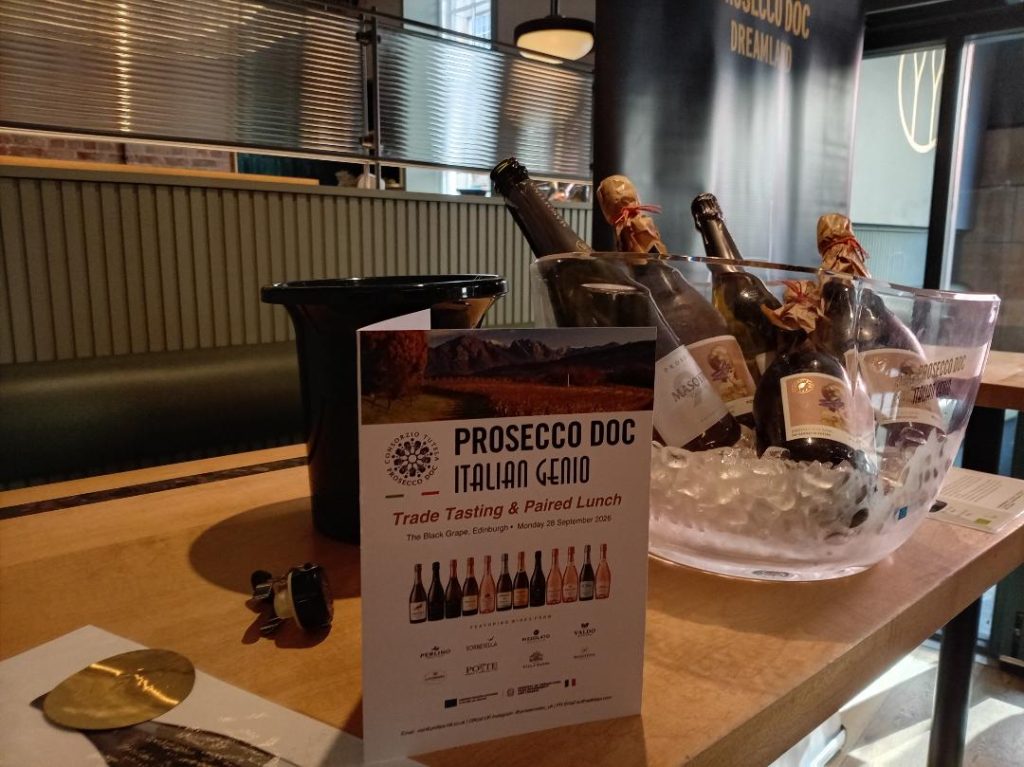
My destination was the Black Grape, and my purpose was no less noble than a Prosecco tasting, an enterprise which, if undertaken with the appropriate gravity, can lead a man into regions of thought from which he may never entirely return.
There was, moreover, the promise of lunch. And I have always maintained that a man who is offered both wine and lunch in the same proposition should not inquire too closely into the circumstances. Thus I proceeded.
The day was bright, the streets were busy, and Edinburgh, with that particular talent she possesses for making ancient stones appear to have opinions, seemed almost to approve of my expedition.
I had been invited to a gathering organised by the capable and evidently indefatigable Diana Thompson of Wine Events Scotland, in collaboration with the vivacious Neil Phillips, official UK Brand Ambassador for the Prosecco DOC Consortium, or, to give the matter its full Italian dignity, the Consorzio di Tutela del Prosecco DOC. Now, before proceeding any further, it is necessary to address a matter which might otherwise trouble the more pedantic among my readers.
The Black Grape does not, in fact, signify that Prosecco is made from black grapes. Nor, as it happens, is the principal grape variety black, mysterious, or remotely inclined to haunt moonlit vineyards. Prosecco is principally made from Glera, a white grape of considerably more respectable habits. I mention this because there are occasions when a man must distinguish between what sounds poetically appropriate and what is actually true.
On this particular day, however, I had little inclination to be troubled by such distinctions. Nothing was going to faze me. Nothing could perturb me. And, by the good offices of Providence and Prosecco, nothing did. I had determined that I would not waste the opportunity by asking Neil the same questions which poor ambassadors, sommeliers and wine producers must endure wherever wine glasses are polished and people are permitted to raise their hands.
What is the ABV? How long is it fermented? Stainless steel? Tank method? Bottle method? Temperature? Yeast? All perfectly respectable questions, of course, but there is a limit to how many times a human being can enquire whether something has been fermented in stainless steel before the stainless steel itself begins to seem like a more interesting conversationalist.
I therefore decided to seize the moment. As the late Texan troubadour Jerry Jeff Walker was reputed to counsel, chances must be taken. Neil was willing. I was ready. And so I fired my first cannon.
“What,” I asked, “is Prosecco’s guilty secret?” The answer came immediately.
“Everywhere.”

There are moments when a word, properly delivered, acquires a magnitude far exceeding its ordinary meaning. This was such a moment. “Everywhere.” For one fleeting instant, my mind conjured the image of Stevie Nicks, the white witch of Fleetwood Mac, floating through a mist of chiffon and prophecy, perhaps holding a flute of Prosecco and whispering ancient secrets concerning the fate of the grape. Then, mercifully, I returned to the secular world. Neil’s meaning was not that Prosecco is produced everywhere.
It is not. Its identity is firmly rooted in its Italian origins and its designated territory. No, the secret was that Prosecco is drunk everywhere.
From Asia to Australia, from one hemisphere to another, the bubbles have marched forth with astonishing confidence. Indeed, France—land of Champagne, Burgundy and other places whose very names can cause a wine enthusiast to sit up straighter—is itself Prosecco’s largest export market. There was something deliciously mischievous about this. Guilt and globalisation seemed to have fused together as effortlessly as the wine itself.
And then came lunch. There are some moments in life when food and wine meet not as strangers introduced at a formal reception, but as old conspirators who have been waiting for an opportunity to resume their activities. A meaty portion of hake arrived, accompanied by a glass of sparkling wine whose green-apple and white-peach character proved to be a revelation.
It was, quite simply, sheer delight. I have eaten lunches on Mondays before. I have drunk wine on Mondays before. But rarely have the two entered into such a harmonious conspiracy. It occurred to me that the calendar itself might have been mistaken. Perhaps it was Sunday. Perhaps it was Friday.
Perhaps Monday, when properly supplied with Prosecco, is merely Friday wearing an unnecessarily serious hat. Having established that Prosecco could travel across continents, I decided to investigate whether it could also survive a social encounter of considerable diplomatic importance.
“A glass of Champagne and a glass of Prosecco walk into a bar,” I announced. The room waited. “What happens?” Again, Neil did not hesitate. “There should be evidence of respect.” Respect. Here, I thought, was wisdom disguised as wine talk. The Champagne and the Prosecco, like two distinguished gentlemen meeting after years of rivalry, ought not immediately to reach for the pistols. They should respect one another.
And in this world of bubbles, there is always a surprise. This seemed to me a fundamental truth extending considerably beyond wine. We all like to be surprised. We all like to be respected. These, after all, are among the foundations of human nature. And if humanity could somehow harness surprise and respect together, perhaps we might become superhuman. Or, at the very least, considerably more pleasant company at dinner. Thus I asked the question which naturally followed.
“If Prosecco had a superpower, what would it be?”
Neil’s answer was almost disarmingly simple. It makes people feel good. Good about themselves. Good about others. And as I looked around the room, I had to concede that there was evidence to support the theory. Throughout the late morning and into the afternoon, the assembled company seemed increasingly cheerful, animated and companionable. Nobody appeared to be preparing for battle. Nobody was challenging anyone to a duel. Nobody was even complaining about the stainless steel.
Perhaps, I thought, the superpower was working.
Neil went on to speak of Prosecco’s versatility and its broad appeal across a wide demographic. Rosé, naturally, had its place at the table, and its perfume seemed to drift through the room with the soothing persistence of a summer memory. Yet Neil also had a challenge for those who sell and serve the wine. Wine bars, restaurateurs and, indeed, the restless consumer might all benefit from recalibrating their Prosecco portfolios. This struck me as sound advice. For we consumers are a fickle tribe.
We demand novelty and then complain that there is too much novelty. We ask for choice and then stand bewildered before the choice. We want tradition, but preferably with something new in it. We want authenticity, provided it is convenient. And above all, we want to be surprised—though only pleasantly.
It was at this juncture that the expedition took an unexpected turn into musical territory. This was not entirely unlike one of those peculiar moments in Mr Benn, when the respectable shopkeeper enters a fancy-dress shop, selects some improbable costume and finds himself transported into an entirely different world. I cannot remember precisely which episode it resembled. Certainly not the pirate one. Or perhaps it was the pirate one.
But this was no time for historical scholarship.
“If Prosecco were a musician,” I asked Neil, “who would it be?”
“U2?”
A respectable suggestion. But before the matter could develop into a rock-and-roll parliament, a delegate standing nearby intervened with the sort of timing normally associated with divine providence, or Madonna herself. Madonna. Of course. Who else? Prosecco, like Madonna, has travelled widely, reinvented itself, refused to remain in one category, and somehow managed to remain recognisable while changing costume. It was therefore settled. At least temporarily.

By this point, the afternoon had acquired the strange elastic quality possessed by certain exceptionally good occasions, when the clock continues to move but time itself appears to have lost interest in enforcing the rules. And so I found myself pondering Mick Jagger. I have never understood precisely what the man was complaining about when he sang of Satisfaction.
After today, I suspect the explanation may be simple. He had never had a Prosecco lunch on a Monday. Had he done so, perhaps the song would never have been written. Perhaps instead he would have stood upon a stage, raised a glass, smiled benignly upon the multitude and sung:
“Quite satisfied, actually.” But this, I admit, is speculation. And speculation, like excessive Prosecco, should always be handled with care. What, then, did I learn from my excursion into the effervescent kingdom? That Prosecco is not merely a welcome drink. It is not merely something poured into a flute while guests arrive and search for somewhere to stand.
It is versatile. It is sociable. It travels. It surprises. It can sit comfortably beside food. It can inspire questions which have nothing whatsoever to do with stainless steel. And, if Neil Phillips is correct—and on this occasion I see little reason to dispute him—it possesses a modest but genuine superpower: It makes people feel good. Good about themselves. Good about others. And perhaps, for a little while at least, good about being exactly where they are.
As for me, I left the Black Grape considerably later than I had intended, with my thoughts somewhat more effervescent than when I had arrived. The streets of Auld Reekie were still busy. The stones were still ancient. Providence had not withdrawn her light. And somewhere, in the vast and inexplicable theatre of human affairs, Champagne and Prosecco were presumably continuing their negotiations. I like to think they were behaving with respect.
After all, in this world of bubbles, there is always a surprise.
And sometimes the greatest surprise of all is discovering that a glass of wine, a plate of hake and a Monday afternoon can teach a man something about the human condition.
Even if he did arrive principally for the Prosecco.